Free, from the world of the Roar of the Dragon novels by Kellen Squire and Michael Tay.
At 0515 on Thursday, April 8, 2027, Master Sergeant Chen sat behind the gun of an M60A3 Patton in a bermed fighting position above Hsinchu beach and cursed as the sand leaped around him. The old American tank shook on its suspension while rockets walked along the first line. In the commander's position above him, Lieutenant Jason Hsu watched through a narrow periscope as the beach defenses disappeared in smoke and orange flashes. Mines fired into empty sand. Concrete obstacles tilted and fell. The intercom carried the only voices the crew could hear clearly.
"Cào nǐ mā!" Chen said.
Around them, Delta Team's four-tank platoon lay hull-down, a soldier's term for a tank hidden behind earth so only its turret showed. The order had been plain. Hold fire. Wait for Fortress Command. The defenders had been in their fighting positions about 36 hours. Outside, the barrage stepped inland in planned belts, breaking the obstacles the ROC engineers had finished in the last week before the landing.
"Delta Team, this is Fortress Actual," Major Wong said over the radio, his voice cutting through static. "Hold positions. Remember the plan: do not—repeat, do NOT—expose yourselves until my command. Let the artillery do its work."
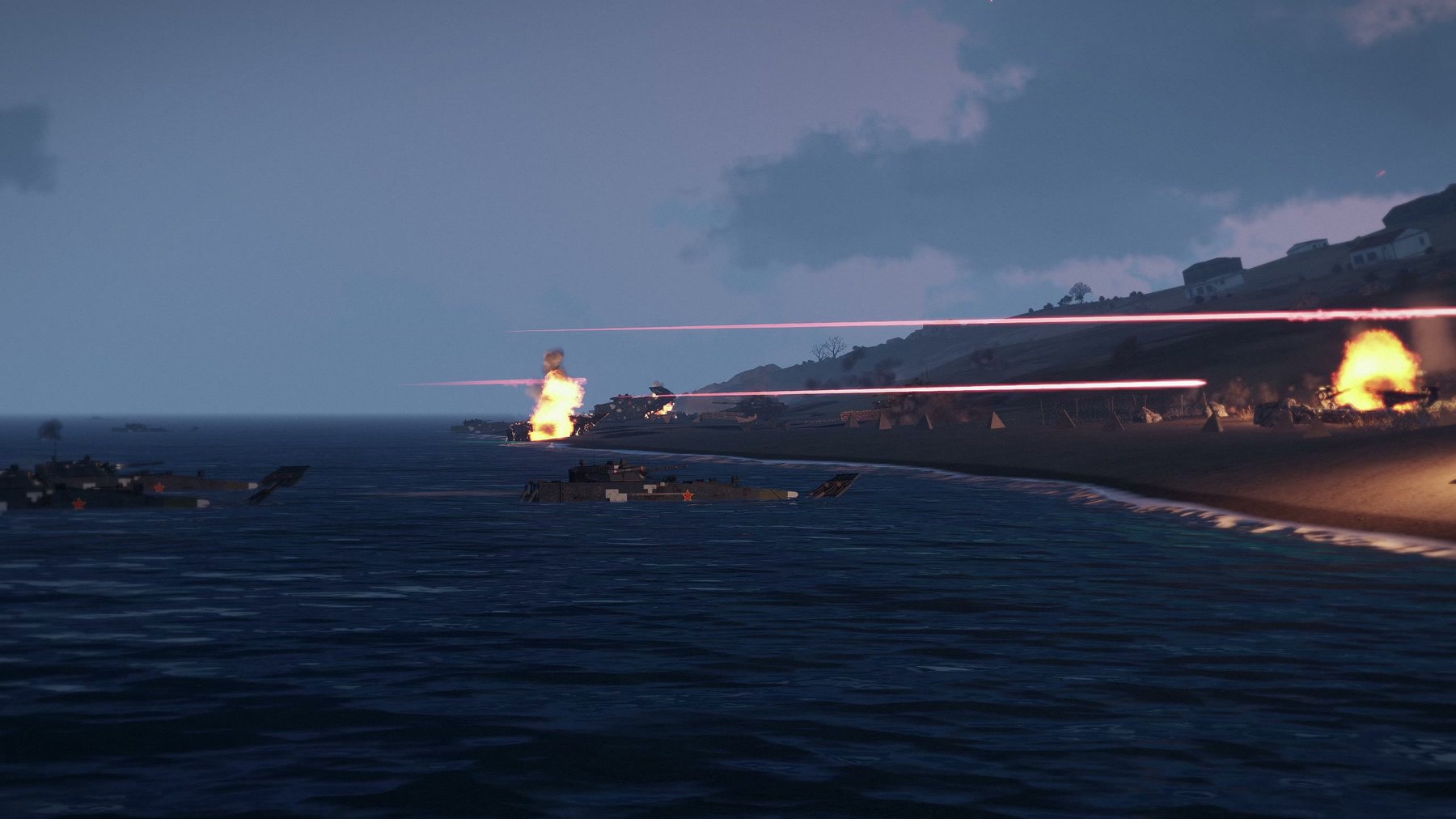
The sea was still dark. Sunrise would come at about 0545, but a patch of dawn sea fog lay over the Strait and blurred the water. Through it came shapes, first as smudges on thermal sights and then as blunt silhouettes throwing white bow waves. They were ZBD-05 amphibious fighting vehicles, fast Chinese marine carriers built to plane across water before crawling ashore on tracks. Mixed among them were ZTD-05 assault guns, similar swimmers carrying a 105mm cannon for killing bunkers and vehicles. They had been launched 10 km out and were coming at 20 knots. Behind them, faster and larger, came Zubr hovercraft and Type 726 air-cushion landing craft, vessels that rode on skirts of air and crossed mines at 50 knots.
"Contact on thermals!" Chen called. "Movement in the water. Multiple… kàn lín lāu-su!"
"All Delta elements, this is Actual," Wong said. "Hold fire. Let Fortress do its work."
The work began from inland. ROC 155 mm guns, heavy artillery pieces firing shells registered on the surf zone before the invasion, opened airbursts above the swimmers and sprayed fragments downward into thin aluminum hulls and exposed decks. Vehicles stopped, slewed, burned and sank. One Zubr lost its lift and wallowed in the surf. Type 726 craft vanished into spray and wreckage. By the end of the first hour, those fires had cost the PLA 80 to 110 swimmers, a Zubr and 4 to 5 LCACs.
But for every vehicle killed, three more got through.
Beijing had accepted that arithmetic months before. On November 15, 2026, the Central Military Commission met and decided to act during American paralysis. From December through March, a four-month mobilization moved under the cover of winter exercises. Depots and piers went up at Xiamen, directly across the Strait. Three invasion fleets, each of 60-plus hulls and mostly requisitioned ferries with a dozen or so escorts, gathered for the largest amphibious assault since Normandy.
Beijing's planners chose April because seas and machinery allowed it. In the central Strait, mean wave height from April to September was under 1.2 m, against up to 2.98 m in December. Sea state 3, a moderate chop, was the April norm, and the PLA's bridge barges were unusable above sea state 3. The northeast monsoon still ran October to April, and April carried its own dangers. Fronts reached Taiwan about 3.4 times in an April, about a 55% chance in any seven days. Fog season in the Strait ran from January to May, and fog peaked at dawn. Still, Beijing's planners chose the April window and put strategic success before tactical surprise.
Outside analysts had long read April as a good month for a crossing. Taipei knew the calendar as well as Beijing did, but it had only months to scramble once it was fully clear that the Americans had abandoned Taiwan. It knew that for certain only a few days before the invasion. The E-2D Hawkeye radar aircraft Taiwan had sought were never delivered after the 2026 Trump-Xi meeting. A new coalition, the Pacific Defence Cooperation Initiative, passed warning, but for political reasons it could not name Taiwan a member. Taiwan fought alone.
For weeks, analysts argued over where the blow would fall. Some expected diversions at Tainan, feints at Taichung, or perhaps a helicopter assault in the south. Beijing helped keep those doubts alive. For a week before D-Day, PLAN warships crowded individual ROC Navy vessels at close quarters, a pressure tactic that stopped only a few hours before the landing. PLA air surges toward the median line forced the ROC Air Force to scramble again and again, burning fuel and flight hours.
Taipei moved what it could. From D-7 to D-3, obstacle belts were completed on the Hsinchu beaches, decoys were placed, and artillery was registered on the surf zone. On D-5, mobilization orders went to the 3rd and 5th Theaters. From D-4 to D-2, submarines sailed to ambush stations, with Hai Shih off the Hsinchu transport area. About 1700 on April 6, beach sectors were occupied by Fortress Command. The 542nd went into hiding north of the Touqian, aircraft dispersed to shelters and tunnels, and forward tank platoons such as Delta Team dug into their berms with orders to wait.
Taipei's plan was simple. Deny the PLA a secure lodgement and a working port, and hold long enough for the invasion's logistics to fail.
The hour at Hsinchu was as deliberate as the month. H-hour fell at 0515, 26 minutes before low water at 0541, when the tide stood at 0.9 m. High water would come at 1140 at 5.0 m. The new moon had passed at 0751 the previous morning, so spring tides ran April 8 to 10, with a Hsinchu tide range of 4.1 to 4.7 m. The PLA staff chose a landing near the bottom of the tide for the reason the Allies had done it in Normandy in 1944. Low water exposed obstacles and let engineers clear them. But the troops and vehicles that survived the surf would have a long exposed run, nearly 2 km, across the Xiangshan flats. The beaching windows for landing craft at Hsinchu would open only from 0840 to 1440, and again from 2111 to 0311.
So the first wave had to swim.
At 0432 the first PLA missile salvo struck Hsinchu Air Base, Taoyuan and the radars. At about 0500 to 0505, the barrage opened and the swimmers launched. On the beach, the old Pattons waited.
"All Delta elements, this is Actual. Swimmers entering the surf zone. Engage."
Chen found a ZBD-05 in the sight. Private Huang, the loader, rammed home a HEAT round, a shaped-charge shell meant to burn through armor with a jet of metal. Hsu gave the order.
"Fire."
"On the way!"
The Patton bucked. The first target burned 800 meters from shore. Others followed, some in the surf, some already clawing toward the flats. The M60A3, with its 105mm gun, was old but deadly against swimming vehicles that had sacrificed armor for buoyancy. Delta Two fired to one side, Delta Five to another.
"Delta One-Two, got one."
"Delta One-Five, two kills, reloading."
"Delta One-Seven, splash four."
A tank to the left lurched forward from its cover, and anti-tank guided missiles, wire-guided or radio-guided weapons built to hunt armor, converged on it. Delta One-Four blew up in a tower of fire. Missiles and rockets began to strike the berms. Small arms crackled over the dunes. The surf became a field of burning hulks and men in the water. The artillery still cut lanes through the PLA, but swimmers kept rising out of the fog.
Then the first marines reached shore, between 0540 and 0555. They came wet, shaken and already under fire. At 0612, Hai Shih, the ROC submarine lying off the Hsinchu transport area, sank the second Hsinchu pier barge. At about 0740, Hai Shih was lost.
Engineers worked under shellfire to join prefabricated sections of a causeway to a Donghaidao mobile dock, a floating pier that could receive vehicles offshore and feed them to the beach. At about 0650, the first Type 96A main battle tank came down the causeway. It was a 50-ton machine with modern armor and a 125mm gun. The forward M60A3s could kill swimmers. They could not stop enough real tanks.
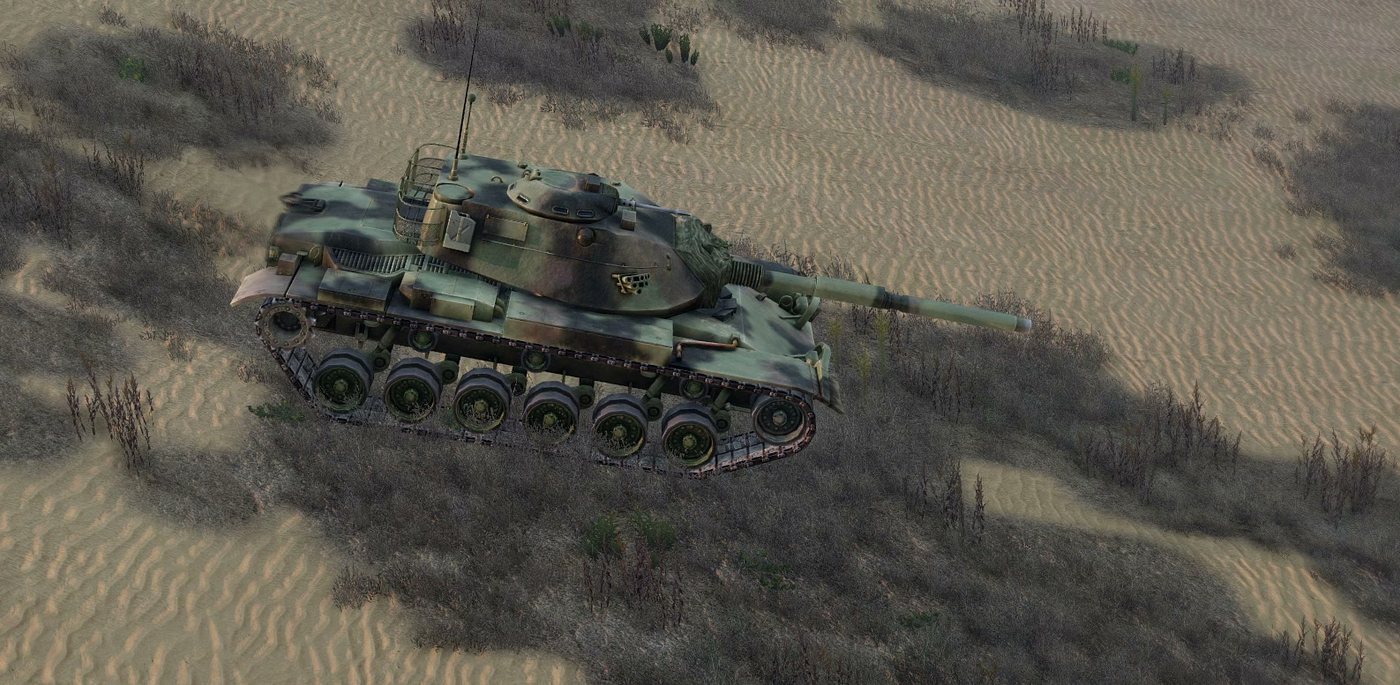
Hsu's Patton fired at a Type 96A and struck its turret face. The shot failed. Moments later, a 125mm round smashed through the old tank. Private Lin died in the driver's compartment. Hsu, Chen and Huang bailed out through smoke and fire and reached a communications trench inland. They were three men from a platoon that had counted 12 at dawn.
The beach line broke. ROC soldiers fell back by rushes, firing from dunes, trenches and concrete, toward Phase Line Bravo. Chen, wounded in the leg, moved with the others. Beyond the worst of the jamming, ROC suicide drones began to appear. These were small explosive aircraft flown or guided into a target, and they found PLA spearheads that had outrun their electronic protection. Before the day was done they killed 15 to 25 vehicles.
Near the secondary line, the three tankers found an abandoned CM-11 Brave Tiger, an ROC tank built from older American hulls and a more modern turret system. Its crew was dead. The vehicle still worked. They cleared it and called in.
"All stations, this is Delta One-Seven. My platoon is gone. My tank is gone. But I've acquired a new vehicle and I have a crew. We are operational. Where do you need us?"
"Delta Seven, this is Fortress Command. Confirm operational status."
"Affirmative. One CM-11, full ammunition load, three crew. We're hurt but we can fight."
Fortress Command redesignated them Fox-Demon One and sent them toward the armor breaking through the second line. At grid 3792, Fox-Demon One killed a Type 96A at 800 m with a flank shot, then moved to 3780.
By 0830, Phase Line Bravo was overrun. The PLA's D-Day objectives had been the Highway 61 line by 0800, the causeway and pier working by 0900, Hsinchu Air Base by 1200 and Highway 1 by 1800. Its planned tempo aimed at decision in 72 hours. At Hsinchu alone, PLA losses from 0600 to 1200 would be counted at 5,000 to 6,000. ROC losses at Hsinchu, concentrated in two beach battalions and the forward tanks, would stand at about 1,800.
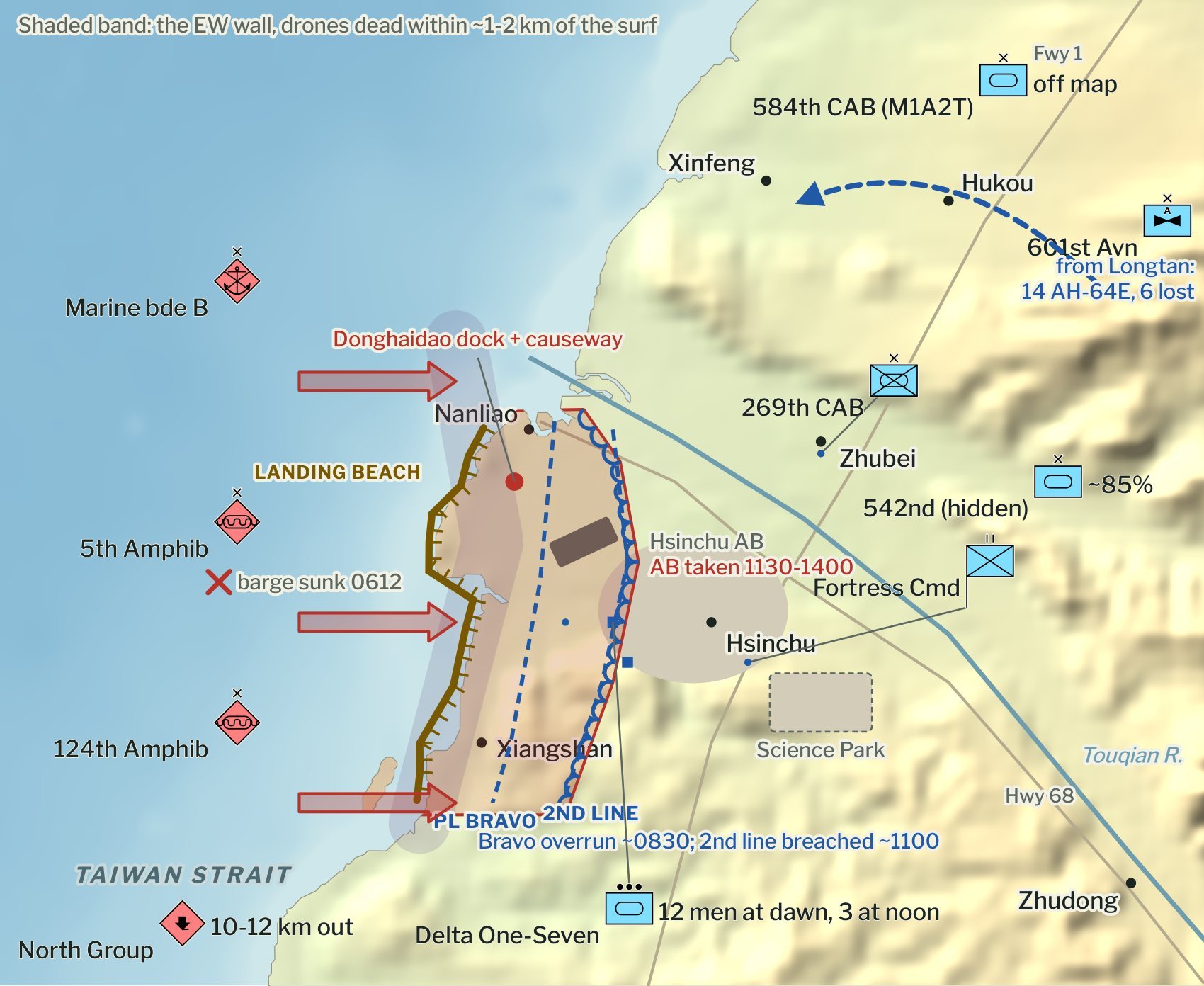
North of the river, 14 ROC AH-64E Apache attack helicopters, heavily armed two-seat machines designed to kill armor, dueled PLA helicopters over the Xinfeng-Zhubei area. Six were lost. At the city edge the second line gave way around 1100, but the ROC retreat remained ordered. The 542nd stayed hidden. The 269th held Zhubei. The 584th waited at Yangmei. The air base, struck before dawn and then fought over through the day, fell between 1130 and 1400.
By 1800, the Hsinchu lodgement measured about 10 km of coast by 3 to 4 km inland. By midnight, 26,600 to 29,400 PLA troops were ashore at Hsinchu. Dry cargo over the Hsinchu beach on D-Day reached 8,900 to 9,900 t, against a plan for both lodgements of 25,000 t.
That night, ROC corvettes and missile craft came out in the first sortie, six Tuo Chiang and 10 Kuang Hua VI vessels, fast small warships built to fire anti-ship missiles in coastal waters. They sank three RO-ROs, roll-on/roll-off ferries carrying vehicles, and a Type 072A landing ship. The price was two Tuo Chiang and five Kuang Hua VI. Fires on the shore and at sea gave the black water a broken red horizon.
On the dunes where Delta Team had waited before dawn, the sand was churned flat and black. Wrecked ZBD-05s lay in the surf, and burned ROC positions marked the berms. The beach at Hsinchu had fallen. The city still held.